
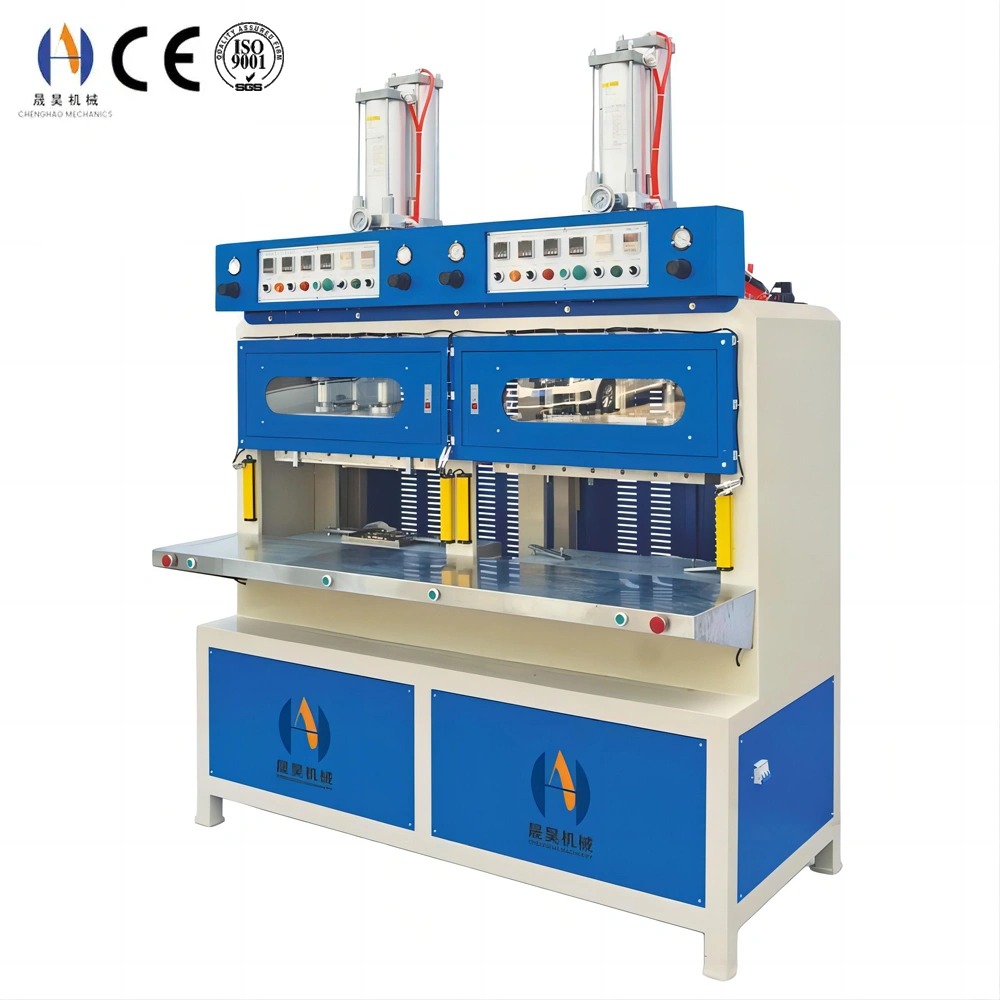
mould machine: Industrial Forming Technical Guide
A mould machine applies controlled heat, pressure, and time to transform raw polymer, rubber, or composite material into finished three-dimensional components. Chenghao Machinery manufactures three primary mould machine families — hydraulic hot press machines, high-frequency forming machines, and blister forming machines — covering the full range of industrial moulding applications from prototype to mass production.
Mould Machine Technology Comparison
| Machine Type | Forming Principle | Pressure Range | Typical Cycle Time | Primary Applications |
|---|---|---|---|---|
| Hydraulic Hot Press | Heat + hydraulic compression | 5–300 ton | 60–300 s | Rubber, thermoset, composite laminating |
| High-Frequency Forming | Dielectric heating + electrode pressure | 0.5–20 ton | 5–30 s | PVC welding, clamshell sealing, blister sealing |
| Blister Forming | Radiant heat + vacuum/pressure | Up to 6 bar | 6–20 s | Packaging trays, clamshell, display blisters |
| Small Hot Press | Electric heating + hydraulic clamp | 1–20 ton | 30–120 s | Lab testing, small parts, prototyping |
Process Parameters by Material Type
| Material | Moulding Method | Temperature | Pressure | Typical Shrinkage |
|---|---|---|---|---|
| Natural rubber (NR) | Compression moulding | 150–170°C | 10–20 MPa | 1.5–3.0% |
| EPDM / silicone rubber | Compression moulding | 160–180°C | 8–18 MPa | 1.5–2.5% |
| PVC (rigid / flexible) | HF forming / hot press | 120–160°C | 1–8 MPa | 0.3–0.6% |
| Carbon fibre / GFRP | Compression moulding | 130–180°C | 5–20 MPa | 0.1–0.3% |
| EVA / foam | Hot press foaming | 155–175°C | 5–15 MPa | 30–50% (designed) |
| SMC / BMC thermoset | Compression moulding | 140–165°C | 5–15 MPa | 0.0–0.3% |
Mould Machine Selection Criteria
Selecting the correct mould machine requires matching five core parameters to your production requirements:
- Clamping force: The minimum force needed to prevent mould opening under internal forming pressure. Calculate as: peak cavity pressure (MPa) × projected part area (cm²) × 1.2 safety factor. Undersized clamping causes flash; oversized clamping wastes energy and stresses tooling. Chenghao hot presses range from 5 to 300 ton to cover all part sizes.
- Platen size: The working surface must accommodate the mould footprint plus perimeter clearance of at least 50 mm per side. Multi-cavity tools for high-volume production require larger platens to house all cavities without platen overhang, which causes uneven pressure distribution.
- Temperature range and uniformity: Electric-heated platens on Chenghao machines achieve ±3°C uniformity across the full platen area. For temperature-sensitive materials such as silicone and EPDM, uniformity below ±5°C is critical for consistent cure and dimensional repeatability across cavity positions.
- Daylight and stroke: Daylight is the maximum open distance between upper and lower platens; stroke is the working travel. Daylight must accommodate the closed mould height plus part extraction clearance (typically mould height + 1.5× part depth minimum).
- Control system: Multi-step programmable control allows independent setting of approach speed, moulding speed, forming pressure, dwell time, and cooling time for each recipe. Chenghao machines support 100-recipe PLC memory for fast job changeover without manual parameter re-entry.
Key Features of Chenghao Mould Machines
- Four-column guided press frame — hardened-chrome guide columns with self-lubricating bronze bushings maintain parallelism within 0.05 mm over full stroke. Consistent platen parallelism ensures uniform cavity pressure distribution critical for flash-free parts in multi-cavity rubber and composite tooling.
- Proportional hydraulic control — servo-proportional valve system enables programmable pressure ramping with 0.1 MPa resolution. Eliminates shock loading on mould and part during closing, extending tool life by 20–35% compared to conventional on/off hydraulic systems.
- Multi-zone electric heating with PID — segmented heating elements with individual PID controllers maintain ±3°C platen temperature uniformity. Rapid heat-up from ambient to 180°C in under 25 minutes, with auto-tuning PID algorithm for stable temperature across varying duty cycles.
- Integrated water cooling — internal water channels in press platens provide controlled post-mould cooling for precision forming of thermoplastic parts. Cooling from 180°C to 60°C in under 8 minutes eliminates off-press cooling fixtures and reduces cycle time by 25–40%.
- 100-recipe PLC with data logging — stores complete process parameter sets for instant job recall. Real-time data logging records temperature, pressure, and cycle time for every production cycle — supports process documentation for ISO 9001 and IATF 16949 quality management systems.
- Quick-change mould system — T-slot platen interface with standardized mould clamping hardware enables single-operator mould change in under 15 minutes for presses up to 100 ton. Hydraulic quick-clamps available on CH-HP-100T and above for sub-5-minute changeover in high-mix production environments.
- Safety-rated guarding — full perimeter light curtains with EN 13849 PLd dual-channel safety relay, interlocked manual access doors, and hydraulic pressure dump on safety activation. Certified to EN 693 hydraulic press safety standard.
FAQ
Q1: What is the difference between compression moulding and transfer moulding in a hot press machine?
In compression moulding, pre-weighed raw material (rubber blank or thermoset preform) is placed directly in the open mould cavity, and the press closes to apply heat and pressure. Material flows only within the cavity. Suitable for thick parts, low-cost tooling, and materials with high viscosity. In transfer moulding, material is loaded into a separate pot above the cavities and transferred through gates when the press closes, providing better dimensional control and insert overmoulding capability. Chenghao hydraulic hot press machines support both methods through different mould tooling configurations without changing the base machine.
Q2: How does platen temperature uniformity affect part quality?
Platen temperature uniformity directly determines cure consistency across all cavities in a multi-cavity tool. A ±10°C variation in a rubber mould at 160°C means cavities over the cool zones cure 8–12% slower than hot zones — resulting in under-cured parts (soft, low tear strength) from cool positions and over-cured parts (brittle, surface degradation) from hot positions within the same cycle. Chenghao's segmented PID heating system achieves ±3°C uniformity, which reduces intra-mould property variation to under 2% for most rubber and thermoset applications. This is especially critical for automotive sealing components and medical rubber parts with tight mechanical property specifications.
Q3: Can the same mould machine handle both rubber compression moulding and EVA foam moulding?
Yes, with appropriate tooling. Both processes use the same hydraulic hot press base machine, but require different mould designs: rubber compression tooling uses tightly fitted cavity blocks with overflow grooves for flash control, while EVA foam tooling uses sealed cavities with controlled expansion clearance to govern foam density. The key machine requirement for dual-use is sufficient stroke to accommodate the taller EVA foam mould (which must have extra daylight for the blowing expansion phase). Chenghao can specify the optimal press model for combined rubber and EVA production lines, or recommend a dedicated machine configuration if both materials are run at high volume.
Q4: What is the role of integrated water cooling in reducing mould machine cycle time?
In thermoplastic moulding on a hot press, the part must cool below its heat distortion temperature before demoulding to avoid warpage. Without integrated cooling, the press must wait for passive ambient cooling or parts must be removed to off-press cooling fixtures — adding 60–180 seconds of dead time per cycle. Chenghao's water-cooled platens reduce in-press cooling time to 3–8 minutes for typical 150–180°C applications, eliminating off-press fixtures entirely. For PVC and polyolefin hot press forming, cycle time reduction of 25–40% is typical. Water flow rate, inlet temperature, and cooling duration are all programmable in the PLC recipe for each job. Refer to the small hot press range for compact configurations with integrated cooling.
Q5: How should clamping force be specified to avoid mould damage?
Two limits govern clamping force specification: the minimum force (to prevent flash) and the maximum safe force for the mould tooling. Minimum: peak cavity pressure × projected area × 1.2 safety factor. Maximum: determined by the mould steel cross-sectional area in compression — a standard P20 tool steel cavity block at 30 mm wall thickness can safely sustain 50–80 MPa compressive stress. Exceeding this causes mould cracking, parting line damage, or guide pin failure. Chenghao's engineers review both limits during mould design review and specify the recommended press tonnage range on the mould drawing. Using a press larger than the specified maximum requires a pressure-limiting valve set to the tooling-safe maximum — standard on all Chenghao CH-HP series machines. Contact Chenghao's technical team for force specification assistance before ordering tooling.
Q6: What are the typical lead times for mould machine procurement and tooling?
Standard hot press machines (5–50 ton, standard platen): 15–20 working days ex-works. 50–150 ton custom-platen configurations: 25–35 working days. 150–300 ton heavy industrial presses: 40–55 working days. Mould tooling lead times run in parallel: simple single-cavity rubber tools (10–15 working days), multi-cavity tools with cooling and ejector systems (20–30 working days), complex composite or foam tooling (25–40 working days). Machine and tooling are designed, manufactured, and factory-acceptance-tested simultaneously at Chenghao's facility. Full FAT documentation — including platen temperature map, parallelism certificate, and PLC program printout — is provided with every machine shipment for quality record compliance.
Get a Mould Machine Quotation from Chenghao
Share your material, part size, production volume, and mould design — Chenghao Machinery will recommend the right mould machine configuration with factory-direct pricing and full technical specification.
Email: sales11@chenghaointernational.com | WhatsApp: +86 15817655869